Three tubs, three completely different results. Here is what pomade, clay and cream each actually do, which one suits your hair, and how to tell them apart on the shelf.
You leave the shop with a great haircut. Four days later it will not do what it did in the chair. Nine times out of ten the haircut is fine — you are just using the wrong product, or the right product the wrong way.
Pomade, clay and cream are the three that cover most heads. They are not interchangeable. Pick by the finish you want and the hair you actually have, not by the tub that looks best.
The short answer
If you read nothing else:
- Pomade — hold plus shine. Combed, tidy, defined. Side parts, slick backs, anything that should look deliberate.
- Clay — the firmest hold with no shine. Thick, gritty texture. Messy crops, textured quiffs, hair that needs to stand up and stay up.
- Cream — the lightest of the three. Control and shape without looking like you used anything. Longer hair, natural looks, and anyone who hates the feeling of product.
Everything below is the long version.
Pomade
Pomade is the classic. It combs through, it keeps a part where you put it, and it leaves shine on the finished hair — anywhere from a low sheen to a proper gloss depending on which one you pick.
Modern pomades come in two families. Water-based pomades wash out with shampoo and can be revived with wet hands the next morning. Oil-based pomades hold longer and shine harder but take real work to remove. Every pomade, clay and cream we carry is water-based, which is the right default for most people.
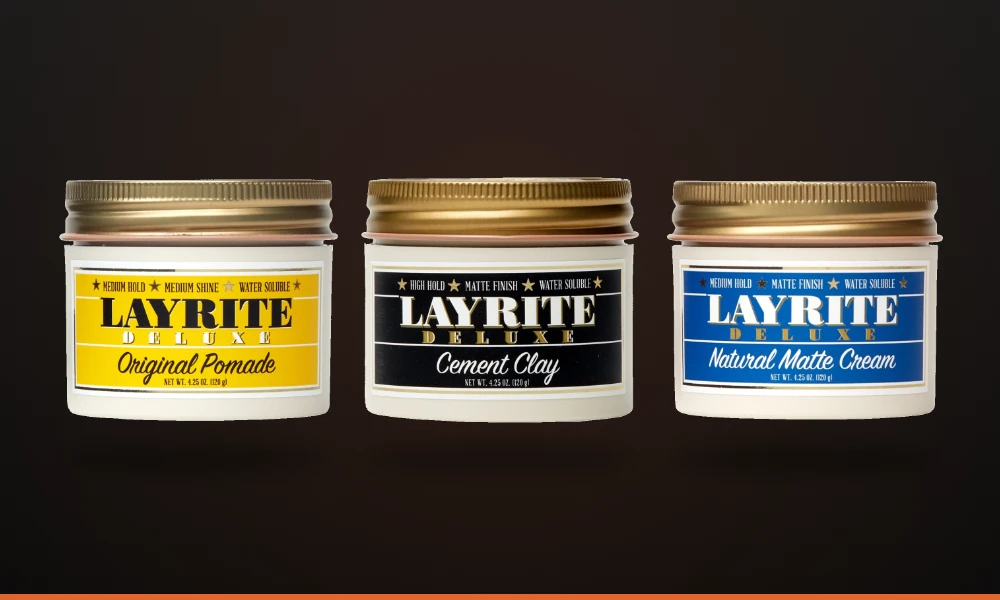
Hold varies more than people expect. Layrite Original Pomade is a medium hold with medium shine — the safe first pomade. Layrite Superhold is the same idea with considerably more grip. Uppercut Deluxe’s Deluxe Pomade is a strong hold with high shine, which is the one to reach for if you want the hair visibly wet-looking and locked. Suavecito Original Hold sits in the middle on both.
There are also matte pomades — Uppercut Deluxe Matte, Suavecito Matte, Byrd Matte — which give you a pomade’s combability with no shine at all. They are a genuinely useful halfway house between a pomade and a clay.
Shine reads stronger on dark hair than on light hair. If your hair is dark and you are unsure, start with a matte or a medium-shine pomade. You can always add gloss; you cannot take it away without washing.
Clay
Clay is the heavy end. It is thicker in the tub, it grips rather than glides, and it dries down to a matte finish that looks like thick hair rather than styled hair. If you want volume that survives a day’s wear, this is the category.
The trade-off is that clay is harder to distribute. It does not comb through the way a pomade does, so it wants to be worked in with your fingers, and it is unforgiving if you use too much.
The clay we carry is Layrite Cement Clay — the firmest hold Layrite makes, with a matte finish. It is water-based, so despite the grip it still comes out with shampoo.
Clay suits short to medium hair, textured crops, and anyone whose hair falls flat by lunchtime. It is the wrong choice for a clean side part — the matte finish and the grit fight the neat look you are after.
Cream
Cream is the one people underrate. It is the lightest of the three, it spreads easily, and it does most of its work on the shape of the hair rather than locking it rigid. Used properly, nobody can tell you have product in.
Layrite Natural Matte Cream is a medium hold with a matte finish, and the useful part is that it stays reworkable — you can run your hands through your hair at four in the afternoon and put it back where it was. A clay will not let you do that.
Cream is the right answer for longer hair, for looks that are meant to move, for taming frizz or flyaways without setting anything, and for anybody who has tried a stiff product and hated the feel of it.
Powder, wax and salt spray
Three more sit alongside the main trio and solve narrower problems.
- Styling powder — Agiva Styling Dust (extra strong, matte) and RedOne Powder Cloud (strong at the root, matte). You shake a little onto dry hair and work it in. It creates volume and grit from nothing, which is why it is the go-to for fine hair that will not hold a shape.
- Wax — RedOne Aqua Hair Wax is a strong hold with a deliberately wet look. Use it when you want the hair to read as slick and sharp rather than natural.
- Texturizing spray — Byrd Texturizing Surfspray is a light, buildable hold with a dry finish. It is less a styling product than a pre-step: work it through damp hair before you dry, and everything you put on top of it holds better.
Salt spray first, then your pomade or clay, is the combination most people are missing. The spray gives the hair grip to work with, so you need far less of the heavy product on top.
Choosing by hair type
Hair type narrows it down faster than anything else.
- Fine or thinning hair — powder first for volume, then a matte pomade or cream. Avoid high-shine pomades: they weigh fine hair down and make it look sparser.
- Thick, coarse hair — clay, or a strong pomade. You have the raw material; you need something with enough grip to control it.
- Curly or wavy hair — cream. It defines the curl without crunching it. Clay tends to separate curls into clumps.
- Straight hair that falls flat — clay or powder. Both give you lift a pomade cannot.
- Longer hair — cream or a light spray. Heavy products at length look and feel greasy.
Then narrow by look. Sharp and combed → pomade. Textured and messy → clay. Natural and soft → cream.
How to apply any of them
The application matters as much as the product. Most people use too much, put it in the wrong place and start at the front.
- Start with a pea. Genuinely. Add a second pea if you need it. More product does not mean more hold — it means heavier, greasier hair that gives up by midday.
- Emulsify it properly. Work it between your palms until it is a thin film and you cannot see it any more. Product that goes in as a lump stays as a lump.
- Back to front, roots first. Hold lives at the root. Push your hands through from the back and the sides, then shape the front last with whatever is left.
- Know your hair’s moisture. Pomade generally goes into damp hair; clay and powder work better on dry hair. Cream is happy either way.
- Shape last. Comb for a pomade look, fingers for a clay look. Do the shaping once and leave it alone.
Why water-based matters
A water-based product dissolves in water. That has three practical consequences: it rinses out with ordinary shampoo, it will not build up on your scalp over a week, and you can reactivate it the next morning with wet hands instead of starting over.
Oil-based pomades — the traditional kind — hold and shine beautifully and are genuinely difficult to wash out. Some people love them for exactly that reason. If you go that route, you need a clarifying shampoo and the patience for two or three washes.
Every pomade, clay and cream on our shelf is water-based. If you are buying elsewhere, the tub will usually say.
Quick answers
Can I mix two products?
Yes, and it is a common trick. Clay for hold plus a little pomade for shine gives you texture that still looks finished. Emulsify them together in your palms before it goes near your hair.
How much should one tub last?
If you are using a pea a day, a standard tub lasts months. If you are getting through one in six weeks, you are using far too much.
Does product cause hair loss?
Styling product sitting on the hair does not cause hair loss. Not washing it out properly can irritate the scalp, which is another argument for water-based. If you are worried about thinning, that is a conversation for a doctor rather than a barber.
What if I already have a haircut that will not behave?
Bring it in. Half the time the fix is a small change to the cut — more weight removed, a different length on top — rather than a different tub.
Which one should I buy first?
Ask your barber while you are in the chair. They have just spent fifteen minutes with their hands in your hair, and they styled it with something.
Do you sell these in the shops?
Yes — the full range is on our products page, and you can buy at the front desk at Maple Ridge, Walnut Grove and Willowbrook. Ask about a specific product before you make the trip.
See what we stock
Eight brands across the three shops. Or book a cut and ask your barber to style it with whatever they would pick for your hair.
 Men’s GroomingHow to Maintain Your Haircut Between Barber Visits
 Beards & ShavesBeard Trim vs Elite Beard Service: Which One Do You Need?